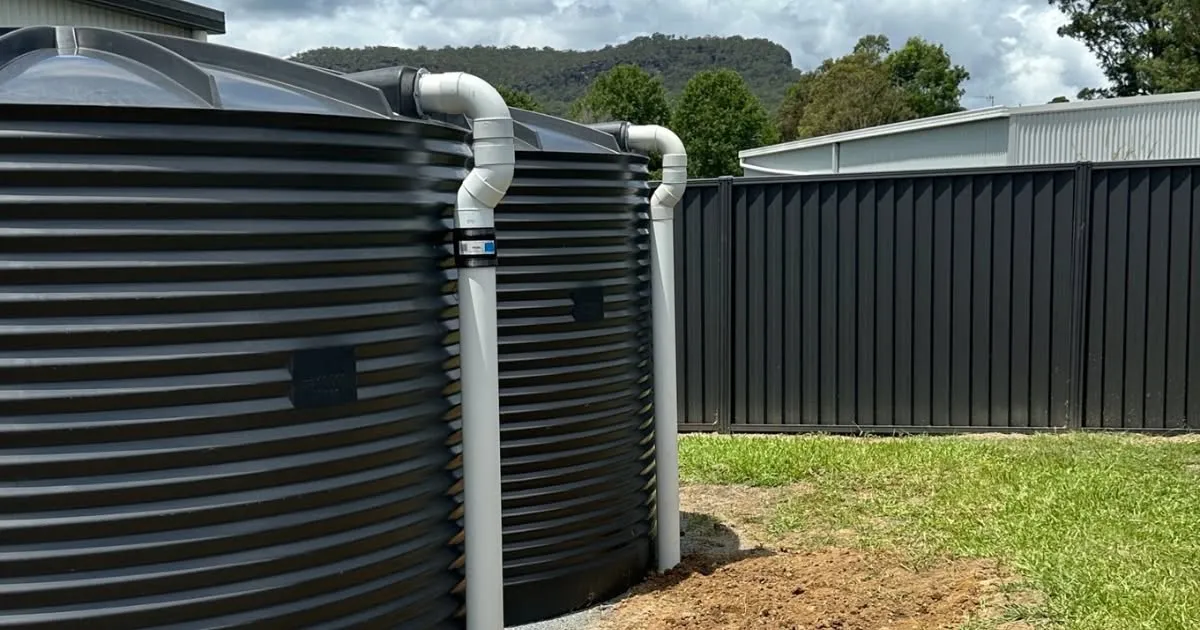
Between storm season downpours and rising water bills, a lot of Coffs Coast homeowners end up asking the same question: is a rainwater tank actually worth the cost? Here’s a straight answer, plus what the rules say and what installation involves.
A rainwater tank is one of the simplest upgrades a home can make, yet it raises more questions than most people expect. How big does it need to be? What can the water actually be used for? Is it legal to just connect it to the toilet? And does a council need to know about it?
Coffs Harbour and the wider Coffs Coast get a decent amount of rainfall across the year, particularly through storm season, which makes the region a genuinely good candidate for rainwater harvesting. This guide walks through the benefits, the legal side of things in New South Wales, and what proper rainwater tank installation looks like, so you can work out if it makes sense for your property.
Quick summary
- A rainwater tank can be legally connected to toilets, laundry and hot water systems, but connecting it to the mains supply requires backflow prevention and a licensed plumber.
- If your property is on Coffs Harbour City Council’s town water supply, the tank generally needs to be registered with Council before installation begins.
- New homes and some larger renovations in NSW are usually required to include a rainwater tank or equivalent to meet BASIX water targets.
- Tank size depends on your roof area, household size and intended use, not just how much space you have in the yard.
- Emerald Beach Plumbing is a Registered Green Plumber and can handle the plumbing side of installation, from guttering connections through to compliant backflow prevention.
How a Rainwater Tank Actually Works
A rainwater tank captures runoff from your roof rather than letting it disappear down the stormwater system. It sounds simple because it is, but the details of how that water is collected and used are where most of the decisions come in.
From Roof to Tank
Rain lands on the roof, travels through the guttering and downpipes, and is diverted into the tank, usually through a first flush device that discards the initial, dirtiest run-off before the cleaner water is stored.
From Tank to Tap
Once water is in the tank, gravity alone isn’t usually enough to run it through household fixtures at a useful pressure, so most setups rely on a pump. From there, the water can supply anything from a garden tap to a plumbed-in toilet system, depending on how the tank has been connected.
Is a Rainwater Tank Worth It?
For most Coffs Coast properties, yes, particularly when the tank is connected to the toilet and outdoor taps rather than just used for the garden. Toilets and outdoor use typically account for close to half of an Australian household’s total water consumption, so shifting that share onto free rainfall rather than mains supply is where the real value sits.
Lower Reliance on Mains Water
Every litre drawn from a tank is a litre that doesn’t show up on the water bill. Water usage in the Coffs Harbour area is billed per kilolitre, so the more of that toilet-and-outdoor share a tank can cover, the more consistently it chips away at the bill rather than delivering a one-off saving.
A Buffer During Heavy Rain
A well-placed tank captures water that would otherwise rush straight into the stormwater system. On a property already dealing with drainage pressure during storm season, that’s a genuine, if modest, benefit alongside proper guttering and stormwater work.
A Buffer Against Water Restrictions
Coffs Harbour City Council can place restrictions on the reticulated water supply during dry periods, limiting things like garden watering from the tap. Because those restrictions specifically target reticulated water, a tank drawing from its own private supply generally sits outside them, so a well-stocked tank can help keep a garden going through a drier stretch.
What Can You Use the Water For?
This is usually the first practical question, and the answer is broader than most people expect, provided the connection is done correctly.
Around the House
Rainwater tank water is commonly used for toilet flushing, washing machines, and hot water systems supplying showers and baths. Each of these uses reduces mains consumption without any change to daily habits.
Outdoors and Around the Property
Garden watering, car washing, and topping up pools, spas or ornamental ponds are all standard uses, along with keeping water on hand for firefighting purposes on larger blocks.
What About Drinking Water?
For properties connected to Coffs Harbour City Council’s town water supply, the public system remains the more reliable option for drinking and cooking, since it’s filtered, disinfected and regularly monitored. A well-maintained tank can still produce good quality water, but anyone intending to drink from a tank, particularly on rural or semi-rural properties around Bellingen or Glenreagh that aren’t on the reticulated supply, should be aware of the risk of microbiological or chemical contamination and consider having the water tested.
The Rules Around Rainwater Tanks in NSW
This is the part most homeowners skip past, right up until it holds up the job. A few rainwater tank installation NSW rules apply specifically to properties in the Coffs Harbour local government area.
Registering Your Tank With Council
If your property sits on Coffs Harbour City Council’s reticulated town water supply, you’ll generally need to register your rainwater tank with Council before work starts, with the registration form submitted at least 10 working days ahead of installation.
Backflow Prevention for Mains-Connected Tanks
A backflow prevention device must be fitted at the water meter whenever a tank is connected to a property’s internal plumbing alongside the mains supply, so tank water can never find its way back into the drinking water system. The type of device depends on how the tank is installed, and Council’s Urban Rainwater Tank Policy sets out what’s required. Where a testable device is needed, it must be registered with Council and tested annually by a licensed plumber. A basic non-testable device doesn’t require that ongoing testing.
Why It Needs a Licensed Plumber
All plumbing work in NSW, including rainwater tank connections, must be carried out by a licensed plumber, with installation and materials complying with AS/NZS 3500. Emerald Beach Plumbing holds Licence 361847C, is fully insured and WorkCover accredited, and is a Registered Green Plumber specialising in water conservation.
BASIX Requirements for New Homes and Renovations
Most new homes built in NSW, along with a number of larger renovations, need to meet BASIX water efficiency targets, and a rainwater tank is one of the most common ways to satisfy that requirement. If a tank is specified on a BASIX certificate, installing it isn’t optional, so it’s worth confirming the required size early in the build process rather than after the roof is on.
Choosing the Right Tank for Your Property
Once the legal side is sorted, sizing and positioning are where the real decisions happen.
Matching Tank Size to Roof and Household
Tank size should be based on your roof’s catchment area and how the water will be used, not just on what fits in the side yard. A tank supplying only the garden can be modest. One plumbed into toilets and laundry for a full household needs considerably more capacity.
Above-Ground or Underground
Above-ground tanks are cheaper to install and easier to maintain, while underground tanks free up yard space at a higher upfront cost. On exposed coastal blocks around Emerald Beach and Sawtell, it’s worth choosing an above-ground tank with UV-stable, corrosion-resistant fittings, since salt air wears down cheaper metal components faster than it does further inland. Otherwise, the right choice usually comes down to block size and budget rather than one being objectively better.
| Above-ground | Underground | |
|---|---|---|
| Upfront cost | Lower | Higher |
| Yard space used | More | Frees up yard space |
| Maintenance access | Easier | Harder, may need excavation for major repairs |
| Best suited to | Larger blocks, budget-conscious installs | Smaller blocks where space is at a premium |
Slimline Options for Smaller Blocks
For tighter suburban blocks around Coffs Harbour, Sawtell and Woolgoolga, slimline tanks positioned along a side boundary or fence line are often the most practical way to fit meaningful capacity without losing usable yard space.
What’s Involved in Installation
Connecting to Your Existing Guttering
A tank is only as good as the water reaching it. During installation we check that your guttering and downpipes are clear, correctly pitched and free of rust or sagging joins, since a clogged or poorly aligned system will starve the tank of water and let more debris through with what does get in, particularly on older homes where gutters may already be showing wear.
Fitting a Pump and Making the Connection
Depending on how the water will be used, this might mean fitting a rainwater tank pump for household connections, installing a first flush diverter and, where the tank ties into the mains, the backflow protection covered above.
Registration and Ongoing Compliance
The final step is registering the tank with Council where required and, where a testable backflow device has been fitted, registering that device with Council and arranging the annual testing that keeps the system compliant. For properties already on a regular plumbing maintenance plan, this can be scheduled alongside other routine checks rather than treated as a separate job.
Frequently Asked Questions
How big a rainwater tank do I need?
There’s no single number that works for every home, it comes down to your roof size and how much of your daily water use you want the tank to cover. A tank feeding just the garden can be a fraction of the size of one plumbed into toilets, laundry and hot water. The fastest way to land on the right figure is to have our team measure your roof and talk through what you want the tank to supply.
Do I need council approval to install a rainwater tank in Coffs Harbour?
Only if your property is connected to Coffs Harbour City Council’s reticulated town water supply. If you are, register with Council before installation starts rather than after, since retrofitting compliance is more disruptive than building it in from day one. Properties on rural or semi-rural supplies outside the reticulated network aren’t subject to the same registration step.
Can I drink water from my rainwater tank?
Legally, yes, though most Coffs Harbour properties on town water don’t need to rely on it. Roof debris, bird droppings and stagnant first-flush water are the main contamination risks, so anyone using tank water as a primary drinking supply, typically on rural properties, should keep the first flush diverter and inlet screens well maintained and have the water tested periodically.
Do I need a pump for my rainwater tank?
For anything beyond a gravity-fed garden hose on a raised tank, yes. Toilets, laundry and hot water connections need a rainwater tank pump to bring the pressure up to a usable level, and it’s worth factoring the pump’s power draw and noise into where the tank ends up sitting, not just the tank’s footprint.
Can a rainwater tank be connected to my mains-supplied home?
Yes, this is the most common setup for Coffs Coast homes, since mains water can top the system up automatically if the tank runs low. The key requirement is a compliant backflow prevention device between the two systems so tank water can never flow back into the drinking water network, fitted by a licensed plumber in line with Council’s Urban Rainwater Tank Policy. Where a testable device is required, it also needs to be registered with Council and tested annually.
Talk to Emerald Beach Plumbing About a Rainwater Tank
A rainwater tank is a straightforward, practical upgrade, but getting the plumbing right, particularly the backflow prevention and council registration, is where a licensed local plumber makes the difference between a compliant installation and a problem down the track.
If you’re weighing up a rainwater tank for your property, our team can talk you through sizing, positioning and rainwater tank installation from start to finish, including the connection to your existing guttering, and handle the registration and compliance side of things.
You’re welcome to call us on (02) 6650 0544 for a free, no-obligation on-site quote.
Or get in touch through our contact page.
As a Registered Green Plumber with over 30 years serving Coffs Harbour, Sawtell, Woolgoolga and the surrounding Coffs Coast, and a fleet of 9 vehicles on the road, we’re well placed to get your rainwater tank connected properly the first time.
You can also see what local homeowners say about our work on our Google reviews.
Emerald Beach Plumbing is a licensed, fully insured plumbing business (Licence 361847C) serving Coffs Harbour, Emerald Beach, Sawtell, Woolgoolga, Bellingen, Nambucca Heads, Macksville and Glenreagh. This article is general information only and doesn’t account for the specific conditions of your property. For an assessment specific to your site, book a free on-site quote.
References
- City of Coffs Harbour, Rainwater tanks, https://www.coffsharbour.nsw.gov.au/Resident-services/Water-and-sewer/Rainwater-tanks
- City of Coffs Harbour, Urban Rainwater Tank Policy, https://www.coffsharbour.nsw.gov.au/Your-Council/Fees-forms-and-publications/Codes-and-Policies/Urban-Rainwater-Tank-Policy
- NSW Health, Rainwater tanks, https://www.health.nsw.gov.au/environment/water/Pages/rainwater.aspx
- NSW Planning Portal, About BASIX, https://www.planningportal.nsw.gov.au/basix/about-basix
- NSW Fair Trading, Plumbing, draining and gasfitting licences, https://www.fairtrading.nsw.gov.au/trades-and-businesses/licensing-and-qualifications/plumbing,-draining-and-gasfitting-licences
- City of Coffs Harbour, Water Restrictions Policy, https://www.coffsharbour.nsw.gov.au/Your-Council/Fees-forms-and-publications/Codes-and-Policies/Water-Restrictions-Policy